You're responsible for the whole web portfolio.
Can you actually see it?
Harvest gives university web leaders a clearer view across independently managed sites — revealing shared platforms, infrastructure patterns, documents, and portfolio activity that are difficult to see when working site by site.
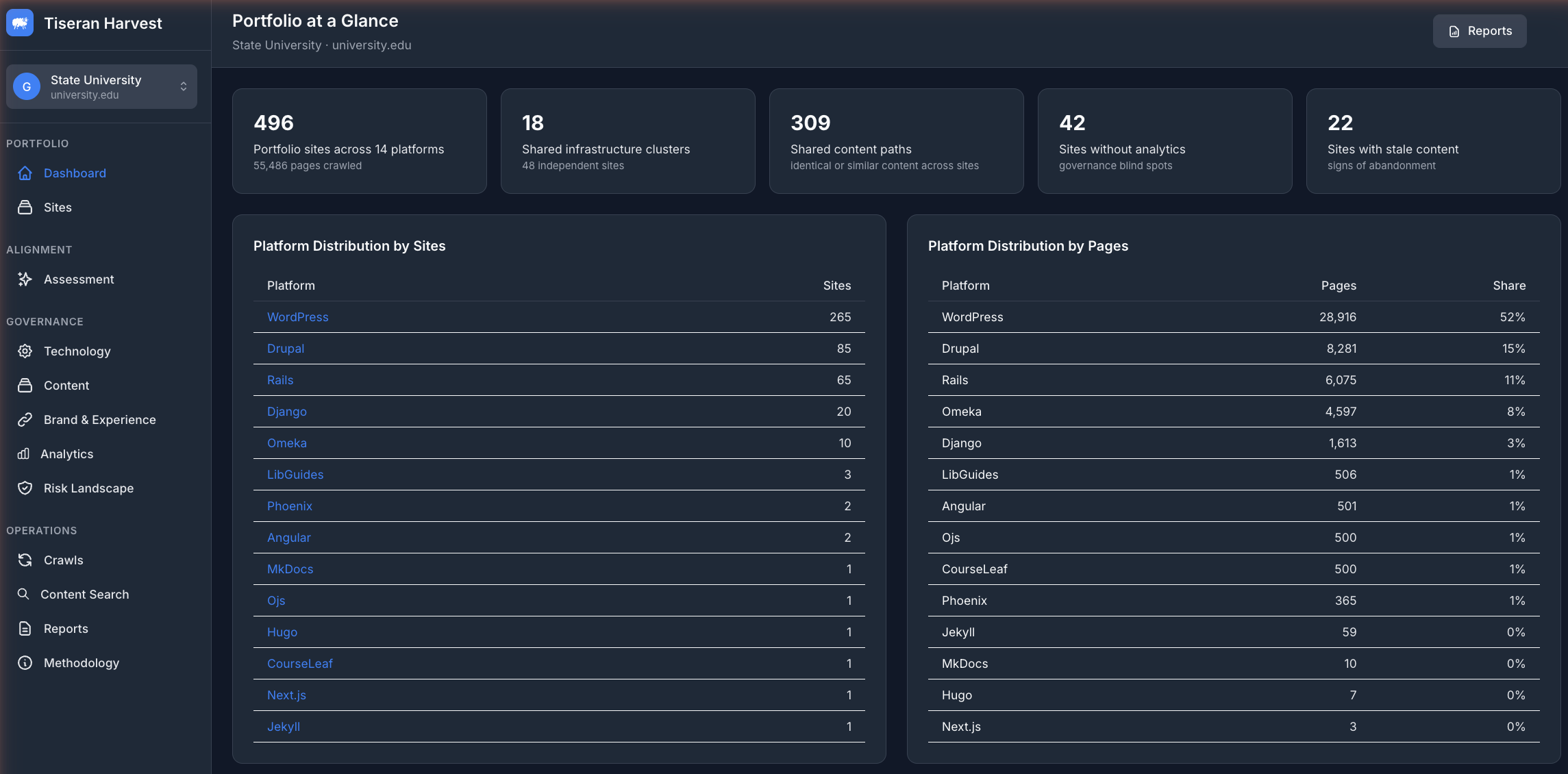
Centralized responsibility. Distributed authority. Incomplete visibility.
You're expected to support accessibility, brand consistency, security, and web strategy across an institution where many of the sites you're responsible for are managed by teams that don't report to you.
The problem isn't that departments have autonomy.
The problem is trying to make portfolio-level decisions without a portfolio-level view.
The picture is hard to keep current
Site inventories become outdated. New microsites appear. Legacy platforms remain in use. Leadership asks questions that may require days of manual investigation.
You're being asked to make strategic decisions with information that can be incomplete almost as soon as you assemble it.
Page-level tools surface individual issues. Harvest adds the structural view behind them.
Accessibility and quality tools are designed to help identify problems at the page and site level.
Harvest adds another layer: which sites share infrastructure, where patterns repeat across the portfolio, and where shared support may create broader impact.
It works alongside the tools your team may already use rather than replacing them.
Consolidation only gets you so far
If your institution has already tried some version of CMS consolidation, you may recognize the pattern.
Some sites move onto the preferred platform. Others remain independent. New sites appear outside the central system. Legacy technology stays in place because moving everything is not always practical.
You still have to understand and govern the portfolio you actually have.
The portfolio intelligence layer
Harvest works from the public web to reveal your institution's web presence as a connected portfolio rather than a collection of unrelated pages and sites.
It surfaces the structural patterns underneath individual properties so you can make better decisions about where shared support may create value, where independence makes sense, and where fragmentation deserves closer attention.
Shared Platforms
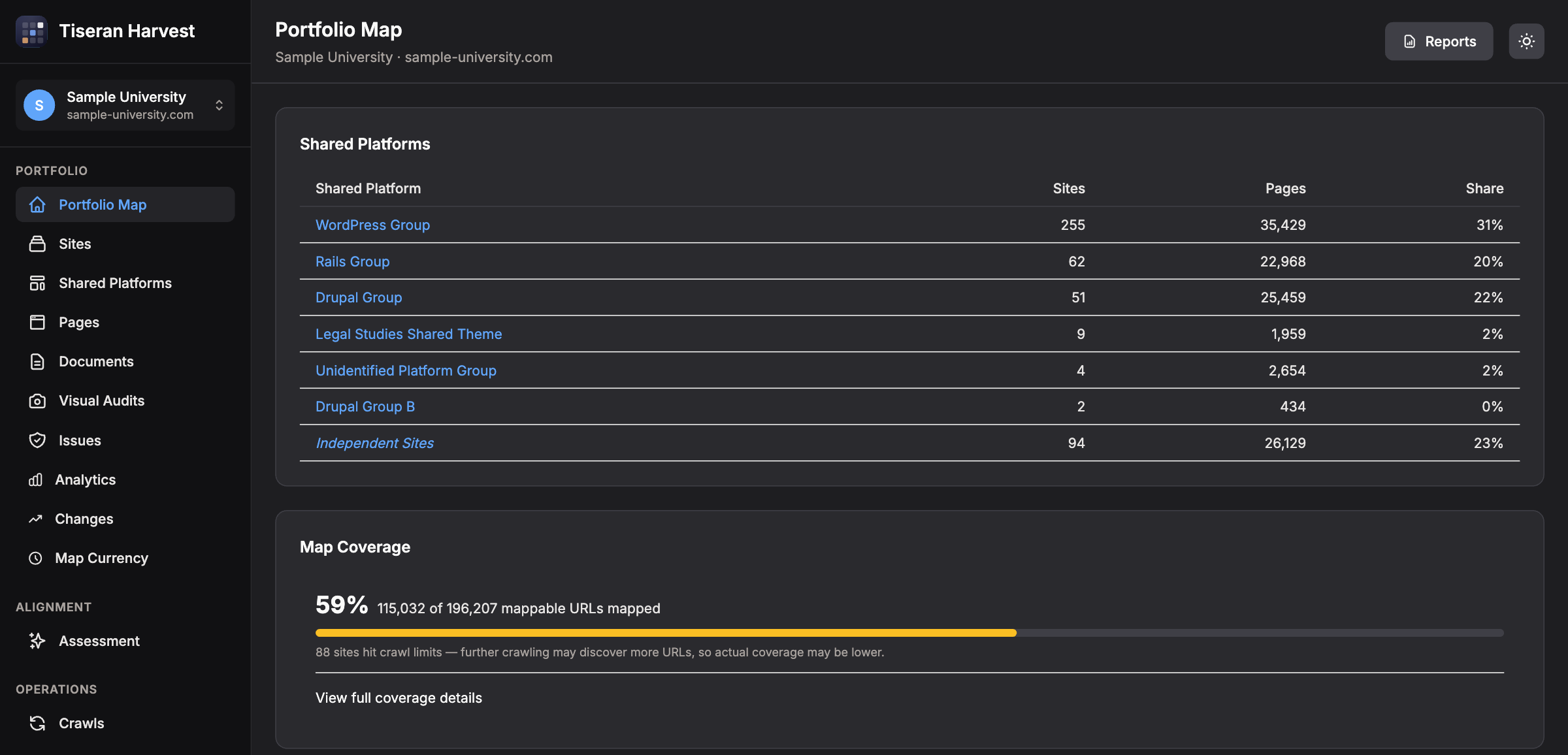
Harvest groups sites that share a CMS, codebase, theme, or platform into infrastructure clusters.
Instead of treating each property as an isolated problem, you can see where multiple sites depend on the same underlying system.
That changes the question from:
"How do we address each site individually?"
to:
"Where could one shared intervention support an entire
cluster?"
Portfolio Change
A single crawl gives you a snapshot.
Comparing recent crawls shows how the portfolio is changing — where platform distribution shifts, where editing activity is concentrated, and which sites have stopped responding.
Patterns that might look like separate incidents can become easier to understand when viewed at the platform or portfolio level.
Intelligence you can use in governance conversations
Harvest provides portfolio-level evidence you can use to answer leadership questions, prioritize support, scope work, and build a clearer case for institutional resources.
Portfolio Analysis
Harvest crawls the public web and builds a structured inventory of the institution's web portfolio.
You see discovered sites mapped to their platforms, with sites grouped into infrastructure clusters when they share a CMS, codebase, or theme.
That helps you answer questions such as:
- Which platforms are we running?
- Which sites depend on each one?
- Which properties operate outside shared infrastructure?
- Which parts of the portfolio appear actively maintained, and which have gone quiet?
Every aggregate finding is backed by the site-level data underneath it.
The Alignment Snapshot Report translates those findings into an executive-ready view that can support governance and leadership conversations.
Content Search
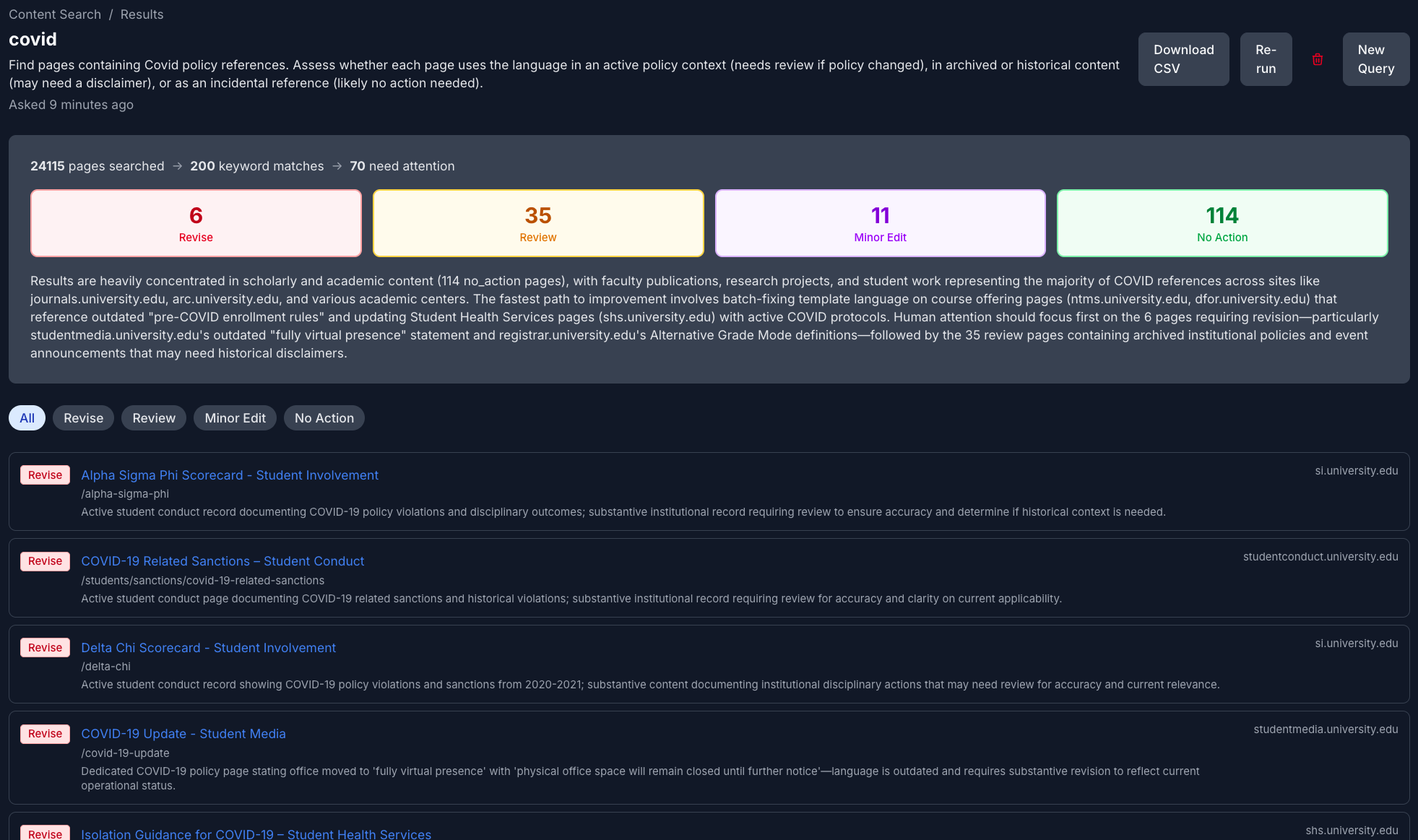
Search for specific content across the public web portfolio.
Harvest finds matching pages and uses AI to classify results according to your governance objective.
Instead of simply asking:
"Does this page contain the term?"
Harvest helps answer:
"Does this page appear to require action?"
A search may return many mentions while revealing that only a subset warrants substantive review.
Each result includes a per-page rationale, with filters and CSV export so your team can work with the output directly.
Documents
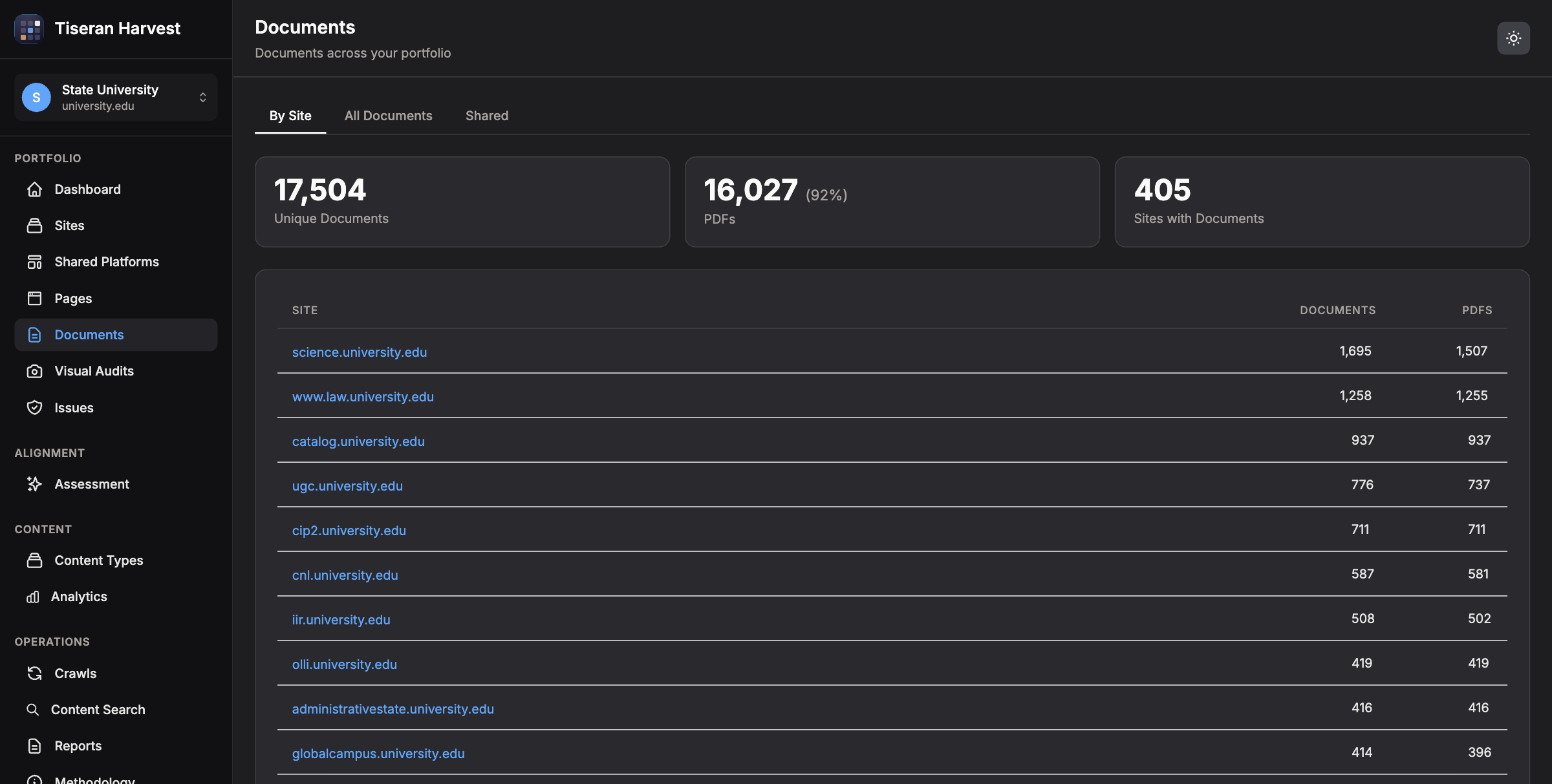
Harvest catalogs documents linked across the public web portfolio, including PDFs, Word files, spreadsheets, and slide decks.
See which sites host them, how widely individual files are linked, and where document-heavy areas are concentrated.
Harvest maps where the files are without opening them.
It locates the work rather than testing the documents themselves.
Changes
A single crawl tells you what the portfolio looked like at that point in time.
The Changes view lets you compare recent crawls so you can see shifts in platform composition, editing activity, and site responsiveness.
If several sites on the same platform stop responding in the same crawl, that shared pattern may point to a common cause rather than a collection of unrelated incidents.
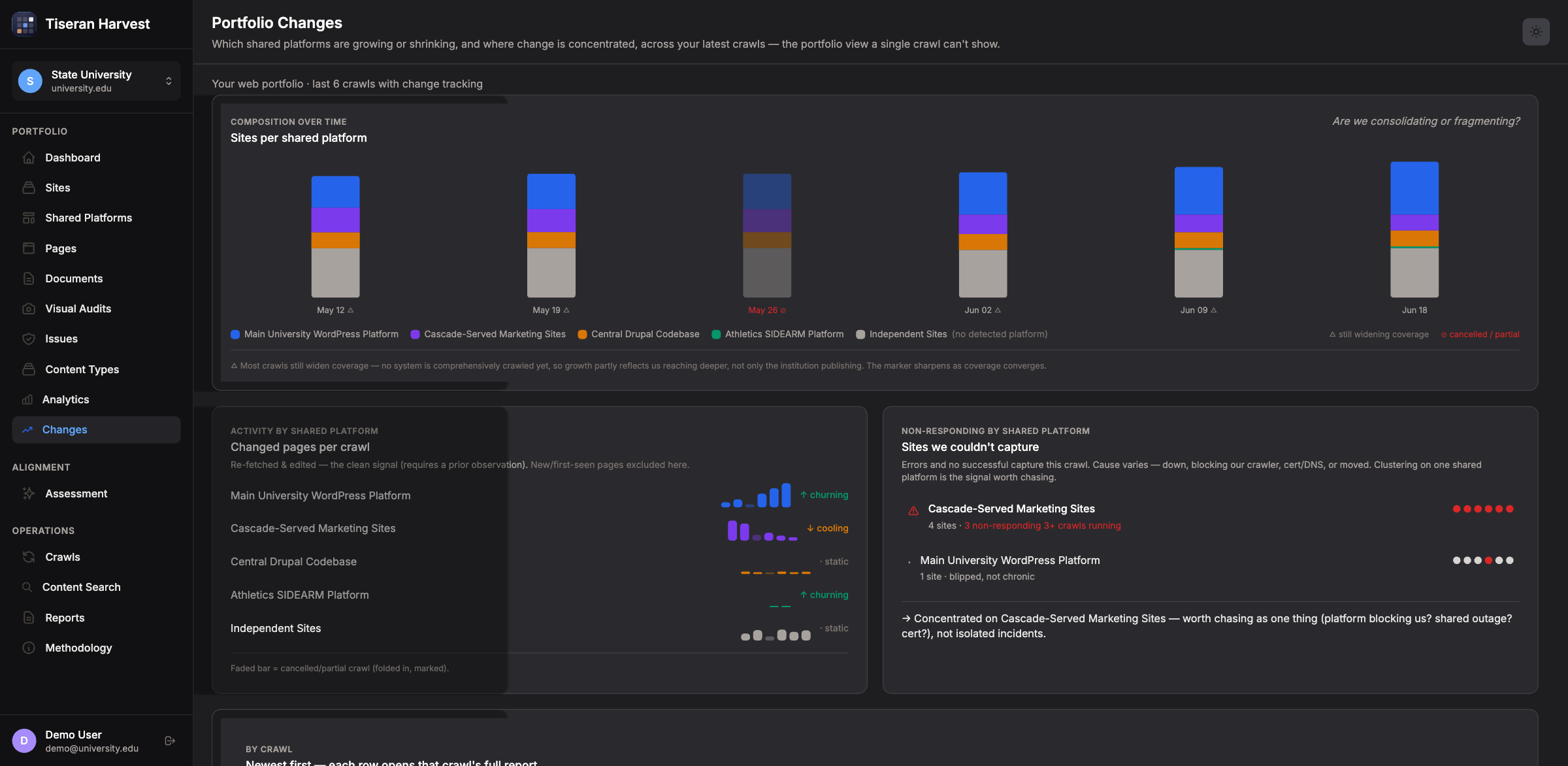
Want to see what portfolio intelligence looks like in practice?
Explore an anonymized analysis of a public university web portfolio.
Built for people responsible for more than they directly control
Harvest is designed for the people expected to understand and support an institutional web presence that crosses organizational boundaries.
Web Strategy & Governance Leaders
You're expected to establish standards, answer leadership questions, and support teams across a portfolio you may not fully control.
Harvest gives you the visibility to focus support where it matters rather than relying on mandates alone.
IT & Infrastructure
Understand the technology footprint behind the institution's public web presence.
See platform distribution, infrastructure clusters, and patterns that may otherwise remain scattered across organizational silos.
Firms & Consultants
Begin a portfolio engagement with a structured view of the public web environment.
Harvest can help accelerate discovery by showing the platforms, sites, documents, and structural patterns present across the portfolio.
From public domain to portfolio intelligence
No agents to install.
No access to internal systems required.
Harvest works from the public web to build a view of the institution as it appears from the outside.
Content behind a login, a form, or some client-side rendering may not be visible.
Point Harvest at the institution
Start with the institution's root domain.
Harvest crawls outward to discover public-facing sites associated with the institution.
Harvest maps what it finds
Each discovered site is analyzed for signals such as CMS platform, codebase, theme, and page volume.
Sites sharing infrastructure can be grouped into clusters so the portfolio begins to take shape as a system.
Portfolio patterns become visible
Instead of looking only at individual properties, you can see platform clusters, document patterns, site activity, and other relationships across the public web portfolio.
Compare recent crawls
As additional crawls are completed, Harvest lets you compare the portfolio across those observations.
That makes it easier to see changes in platform composition, editing activity, and site availability over time.
You don't need one CMS to have one institutional view.
University web portfolios are often federated because universities themselves are federated.
Schools, departments, research centers, and administrative units have different needs. Some properties may belong on shared infrastructure. Others may have good reasons to remain independent.
Harvest doesn't begin by asking you to eliminate that complexity.
It begins by making the public portfolio more visible.
With portfolio intelligence, the institution can see where shared support may create leverage, where independent systems warrant attention, and where autonomy is working as intended.
Visibility gives the center a way to support without taking control.
Start by seeing what's actually there
Web portfolios vary in size and complexity.
We're working with early partners to shape pricing that reflects the scope of the portfolio and the value Harvest provides.
If you're interested in seeing what Harvest could reveal across your institution, let's start with a conversation.
Book a ConversationBuilt from 17 years inside the problem
Tiseran is led by Danny Collier, who has spent 17 years working in higher education digital strategy and web governance.
That experience includes the reality behind institutional web portfolios: inherited platforms, decentralized publishing, partial consolidation efforts, distributed authority, and central teams expected to make sense of all of it.
Harvest grew from a simple observation:
Many web governance tools are designed around individual pages, sites, or specific platforms. Harvest adds another layer: a view across the portfolio itself.
You cannot make portfolio-level decisions without portfolio-level visibility.
Harvest is designed to make that layer visible.
What would change if you could see
the portfolio more clearly?
- Which platforms are carrying the most institutional weight?
- Where could shared support create the greatest leverage?
- Which problems that appear separate may actually be connected?
- Where is independence working well — and where does fragmentation deserve a closer look?
Harvest gives you the evidence to start answering those questions.
Book a Conversation